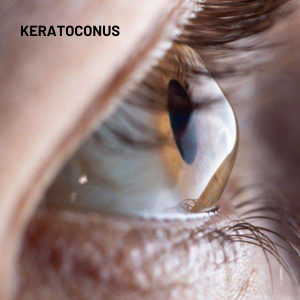

Keratoconus
Keratoconus
Retinitis Pigmentosa (RP) is a group of rare, inherited eye disorders that cause progressive degeneration of the retina, the light-sensitive tissue at the back of the eye. Over time, RP leads to vision loss, and in severe cases, blindness.
How does keratoconus affect your vision?
Keratoconus changes vision in two ways:
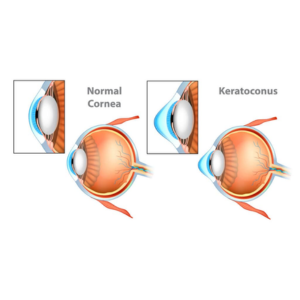
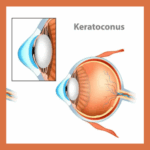
- As the cornea changes to a cone shape, the smooth surface also warps. The term for this is irregular astigmatism. Glasses can’t fully correct irregular astigmatism.
- As the front of the cornea steepens, your eye becomes more nearsighted. As a result, you may need new glasses more often.
How common is keratoconus?
One estimate says that keratoconus develops in 50 to 200 of every 100,000 people.
What are the symptoms of keratoconus?
The main symptoms of keratoconus include:
- Gradually worsening vision in one or both eyes. (Generally, keratoconus affects both eyes.)
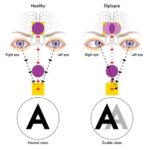
- Having double vision when you look out of just one eye.
- Seeing halos around bright lights.
- Being sensitive to light. (The term for this sensitivity is photophobia.)
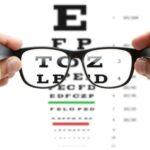
- Having vision that gradually becomes distorted. With distorted vision, straight lines might look curvy or bent, and objects don’t have their correct shape.
What causes keratoconus?
The cause of keratoconus is largely unknown. Some studies have found that keratoconus runs in families, and that it happens more often in people who have certain medical conditions.
In most cases, you don’t have an eye injury or a disease that leads to keratoconus. People with keratoconus tend to rub their eyes a lot, which may cause the condition to develop more rapidly.